
Routine laboratory handling and sterile procedures have different glove requirements. Examination gloves may be appropriate for routine tasks, while procedures that require a sterile barrier need gloves selected for that purpose. This guide explains how to assess sterile gloves for laboratory use, including material choice, packaging, quality documentation and handling. Sterile gloves should not be assumed to be RNase-free.

When to Choose Sterile Surgical Gloves
- Tissue and cell culture — glove selection should follow the laboratory’s validated aseptic procedure. Sterile gloves may be appropriate when hands could contact sterile materials or critical surfaces.
- Sterile compounding — follow the applicable compounding requirements. USP <797> guidance specifies sterile, powder-free gloves for compounding Category 1, 2 and 3 CSPs.
- Pharmaceutical cleanrooms — select gloves according to the process, cleanroom requirements and the facility’s contamination control procedures.
- Surgical procedures — use sterile surgical gloves in accordance with the product’s intended use and the clinical protocol.
Where a procedure requires sterile gloves, use a sterile product and follow the facility’s requirements for packaging, donning and replacement.

What to Look For
For sterile work, look for:
- Intact sterile packaging — check the sterile barrier, expiry date and storage instructions before use.
- Validated sterilization — review the product’s sterilization information. Electron-beam sterilization is one method; it is not a universal requirement for laboratory gloves.
- Freedom from holes — check the applicable standard and AQL. EN 455-1 specifies AQL 0.65 for surgical gloves; this is a lot acceptance parameter, not a sterility measure. See the IFC/BSI technical benchmarking guide.
- Powder-free construction — check the product specification and any additional requirements for particles or extractables.
Sterility does not establish RNase-free status. For RNA-sensitive work, request product-specific RNase test documentation and follow the laboratory’s contamination control procedures. NEB explains that RNases can sometimes survive autoclaving and recommends frequent glove changes.

Latex vs Polyisoprene: Which to Choose?
Feature | Natural Latex | Polyisoprene (PI) |
|---|---|---|
Cost | Lower | Higher |
Tactile sensitivity | Excellent | Excellent |
Allergy risk | Latex protein allergy possible | Latex-free |
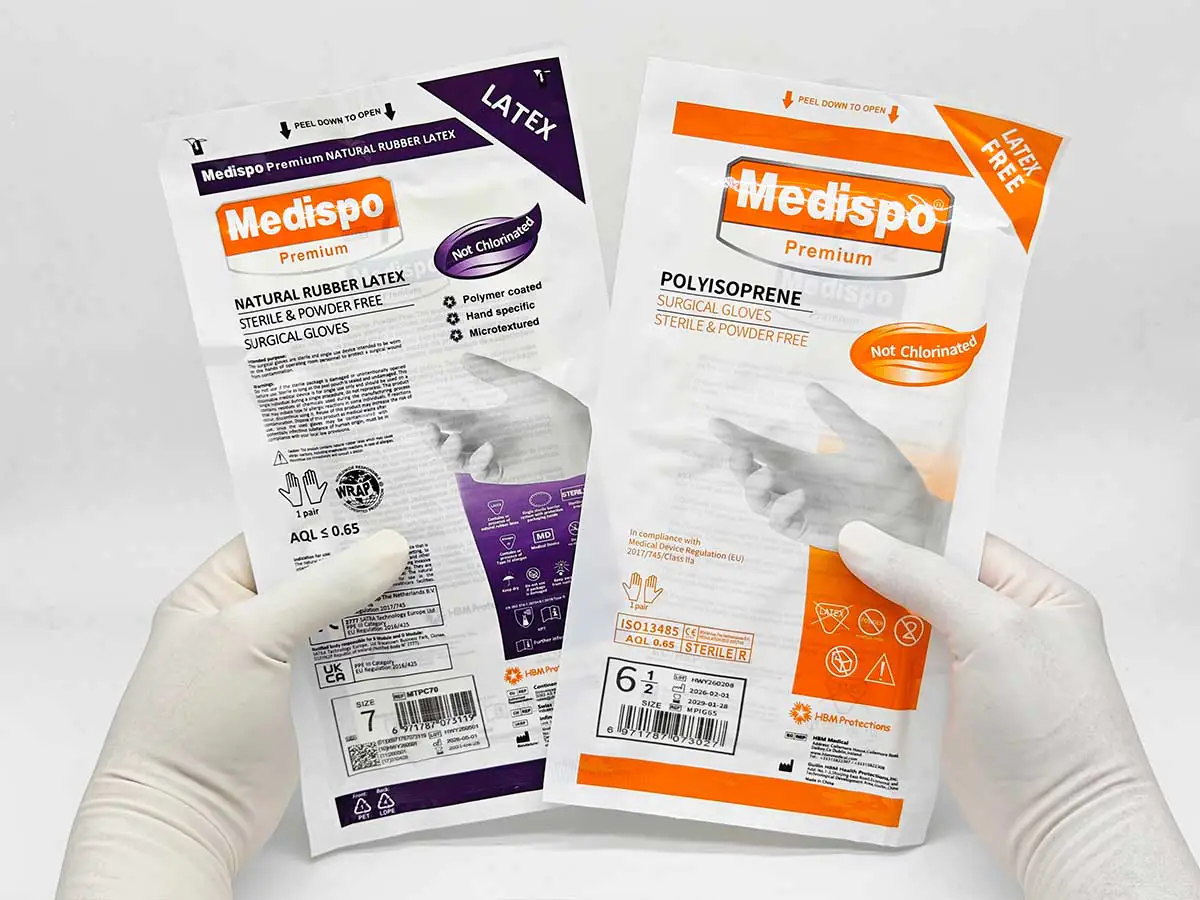
Selection consideration | Natural rubber elasticity; consider latex protein allergy | Synthetic alternative with latex-like elasticity and no natural rubber latex proteins |
Latex and polyisoprene gloves can be considered where the selected product meets the procedure’s requirements. Polyisoprene avoids natural rubber latex proteins. For laboratory use, also review chemical compatibility and any requirements for particles, extractables or other contaminants.
Look at Manufacturing Quality
Laboratory buyers should ask suppliers:
- What individual glove inspection methods are used?
- Which standard, AQL and sampling plan apply to freedom-from-holes testing?
- What production environment controls are in place?
- Can the supplier provide current ISO 13485 documentation and product-specific compliance documents?
HBM Protections manufactures Medispo surgical gloves. Each glove is 100% air inflated and undergoes 7-stage quality inspections before delivery. These inspections do not establish RNase-free status or replace validation of sterilization.

Donning and Technique
Correct handling helps preserve the glove’s role in contamination control:
- Perform hand hygiene and allow hands to dry before donning.
- Use aseptic donning technique to avoid contaminating the outer surface.
- Change gloves between tasks or samples as required by the laboratory’s procedure.
- Replace torn or contaminated gloves immediately.
For RNA-sensitive work, change gloves after touching skin, door handles or other shared surfaces. Thermo Fisher Scientific’s RNase control guidance explains why frequent glove changes are necessary.
HBM Protections and Medispo
HBM Protections supplies sterile surgical gloves under the Medispo brand, including:
- Powder-free natural latex sterile surgical gloves
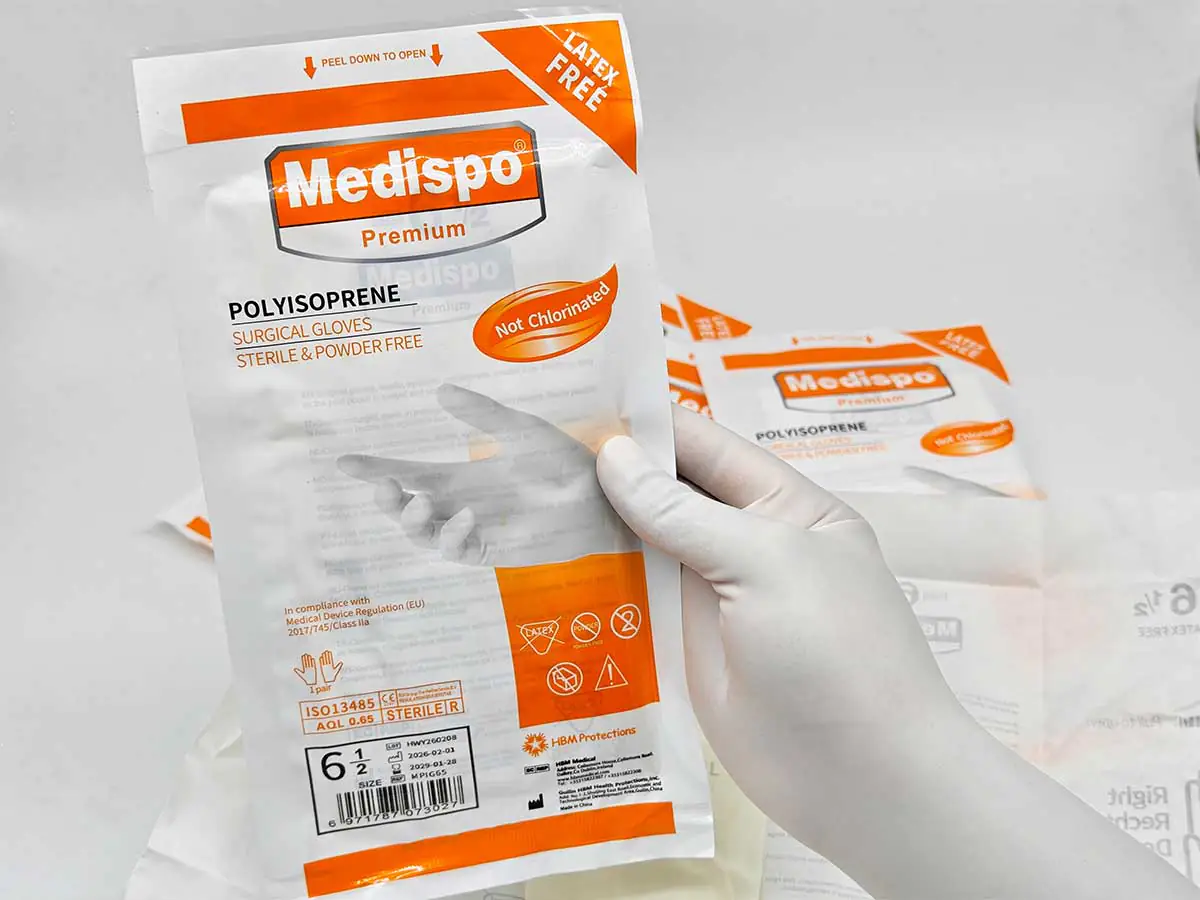
- Powder-free polyisoprene sterile surgical gloves
- T-Polyure coated (TPC) gloves for easier donning with damp hands
To discuss glove specifications and the documentation required for your application, contact us for samples and product information.
For laboratory applications, suitability should be assessed against the selected product’s instructions for use and the facility’s process requirements.