Orthopaedic procedures such as fracture reduction, internal fixation, and joint replacement may involve sharp bone edges, bone fragments, drills, K-wires, and reamers. These contacts and instrument movements place mechanical stress on surgical gloves. Glove selection therefore needs to consider barrier integrity alongside fingertip feel, fit, and instrument handling.
An observational study of orthopaedic trauma procedures examined 304 gloves collected from 15 procedures and identified perforations in 18 gloves, or 5.9%. Only 30.7% of outer-glove perforations were noticed by the wearer when they occurred. These findings illustrate why glove damage may go undetected during a procedure and why glove selection and gloving practices deserve attention in orthopaedics.
How do orthopaedic gloves differ from standard surgical gloves? When should buyers consider latex or latex-free options? This guide explains the design considerations and compares the two Medispo orthopaedic surgical glove options.
What Are Orthopaedic Surgical Gloves?
Orthopaedic surgical gloves are designed for the handling demands of orthopaedic procedures. They typically feature a thicker construction while also addressing fit, grip, and freedom of finger movement.
“Orthopaedic” describes the glove’s intended application rather than its material. Orthopaedic gloves may be made from natural rubber latex or synthetic materials such as polyisoprene (PI).
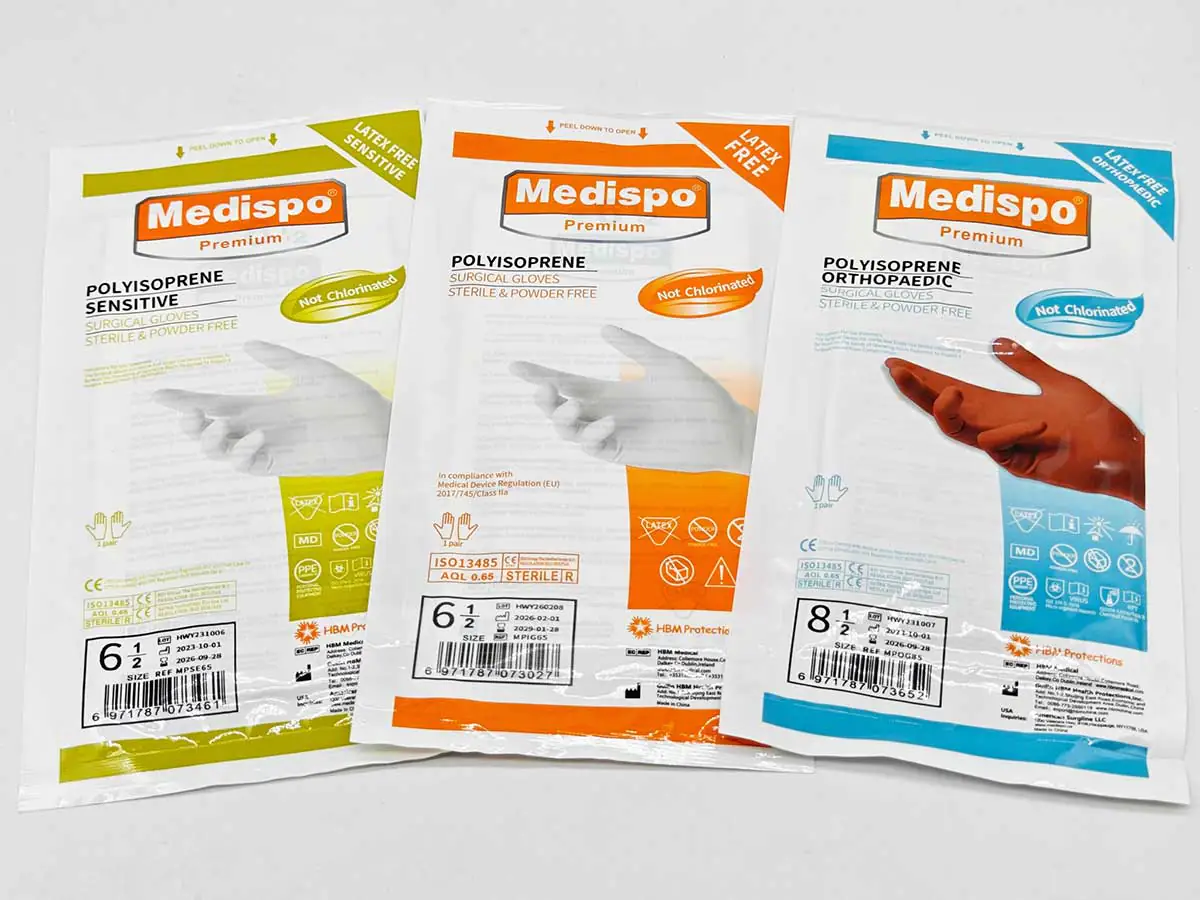
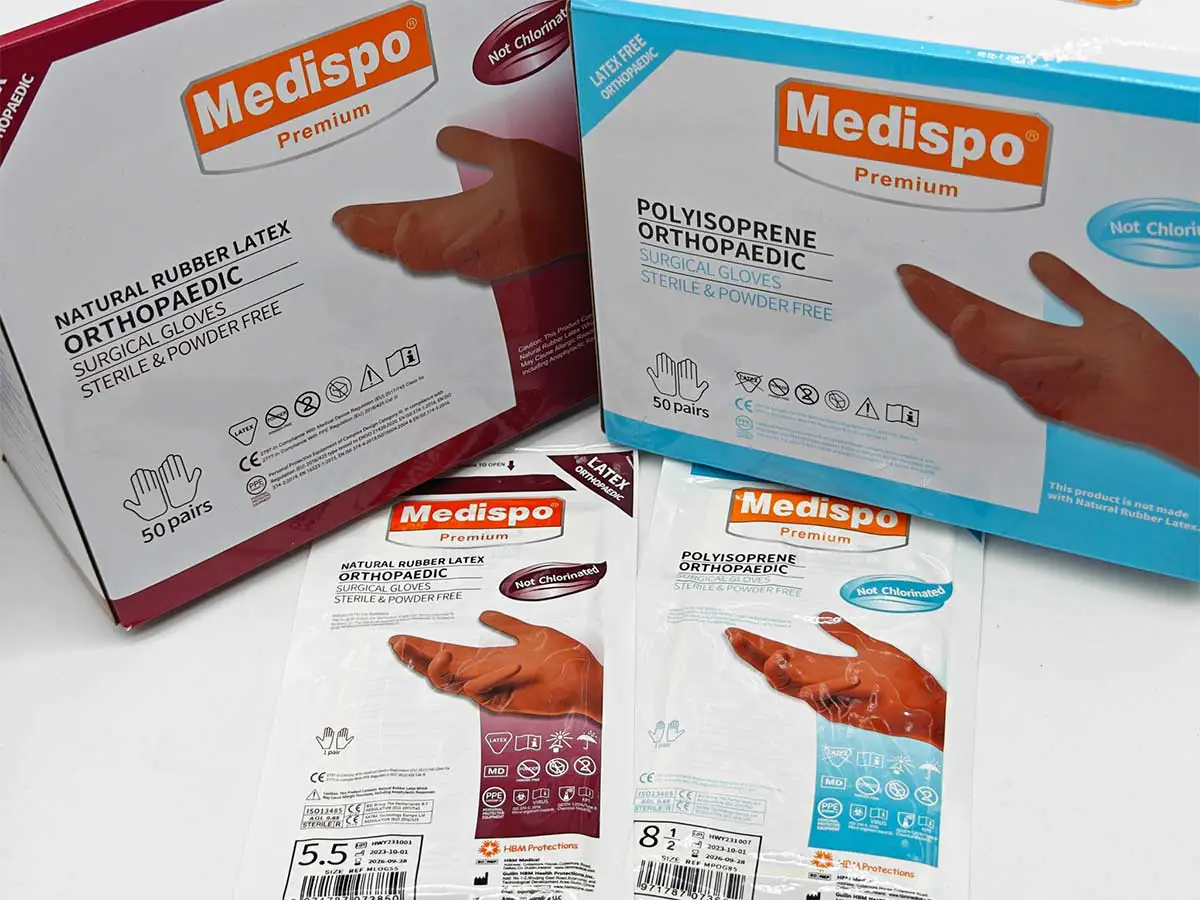
Medispo offers both natural rubber latex and latex-free PI orthopaedic surgical gloves. Both are brown, sterile, and powder-free, providing options for procurement programs with different material requirements.
How Do Orthopaedic Gloves Differ from Standard Surgical Gloves?
The main differences concern construction thickness and design priorities. Buyers should compare the specifications of individual models rather than relying on the product name alone.
| Comparison Point | Standard Surgical Gloves | Orthopaedic Surgical Gloves |
|---|---|---|
| Design priorities | Balance tactile feedback, fit, and flexibility for general surgical use | Combine a thicker construction with the handling demands of orthopaedic procedures |
| Thickness | Varies by material and model | Typically thicker; compare measurements at specific glove locations |
| Wear-trial priorities | Fingertip feel, grip, and wearing comfort | Assess fingertip feedback, grip, and finger movement with the thicker construction |
| Material options | Latex and latex-free options are available | Latex and latex-free options are also available |
| Selection criteria | Intended use, material requirements, and wearer feedback | Orthopaedic handling requirements, product specifications, and wearer feedback |
Compare fingertip, palm, and cuff thickness separately. A measurement at one location does not describe the thickness of the entire glove.
Thickness alone does not establish puncture resistance. If a purchasing specification includes a particular mechanical performance requirement, review the test method and results for the exact model.
When Should Buyers Consider Orthopaedic Surgical Gloves?
Consider orthopaedic gloves when the intended procedure calls for evaluating a thicker construction, particularly for bone handling and repeated orthopaedic instrument use. Fit and handling should then be assessed through sample trials.
Procedures Involving Bone Surfaces, Bone Fragments, and Orthopaedic Instruments
Contact with bone surfaces and fragments, together with the use of drills, K-wires, and other instruments, creates situations in which glove damage deserves particular attention.
A study of gloves caught in surgical rotary instruments found that some resulting microperforations were not detected by visual inspection. The study concerned gloves that had already become caught in rotary equipment; its findings should not be interpreted as the perforation rate for all orthopaedic procedures.
Buyers can explain the intended application to the supplier and compare glove thickness, fit, and grip through product specifications and sample trials. A thicker glove does not replace appropriate instrument handling or timely replacement following damage.
Sustained Instrument Handling
Repeated gripping, rotating, and repositioning of instruments make glove fit and grip relevant to selection.
During a wear trial, observe whether users need to adjust the glove frequently, whether excess material gathers across the palm, and whether finger flexion feels restricted. Once the required specifications are met, the glove should also be assessed for the movements the team routinely performs.
For procedures expected to take longer, evaluate comfort during sustained wear. Glove selection and replacement arrangements should follow the procedure requirements and the team’s established practices.
Changes to Single- or Double-Gloving Arrangements
When changing glove models or introducing double gloving, evaluate the complete configuration.
An outer glove that fits well on its own may feel different over an underglove. Trial the intended inner and outer models together, checking finger movement, cuff position, and instrument grip.
Which Medispo Orthopaedic Surgical Gloves Are Available?
HBM Protections manufactures Medispo orthopaedic surgical gloves in natural rubber latex and latex-free polyisoprene. The two options allow buyers to consider material requirements alongside thickness and wearing preferences.
Medispo Latex Orthopaedic Surgical Gloves
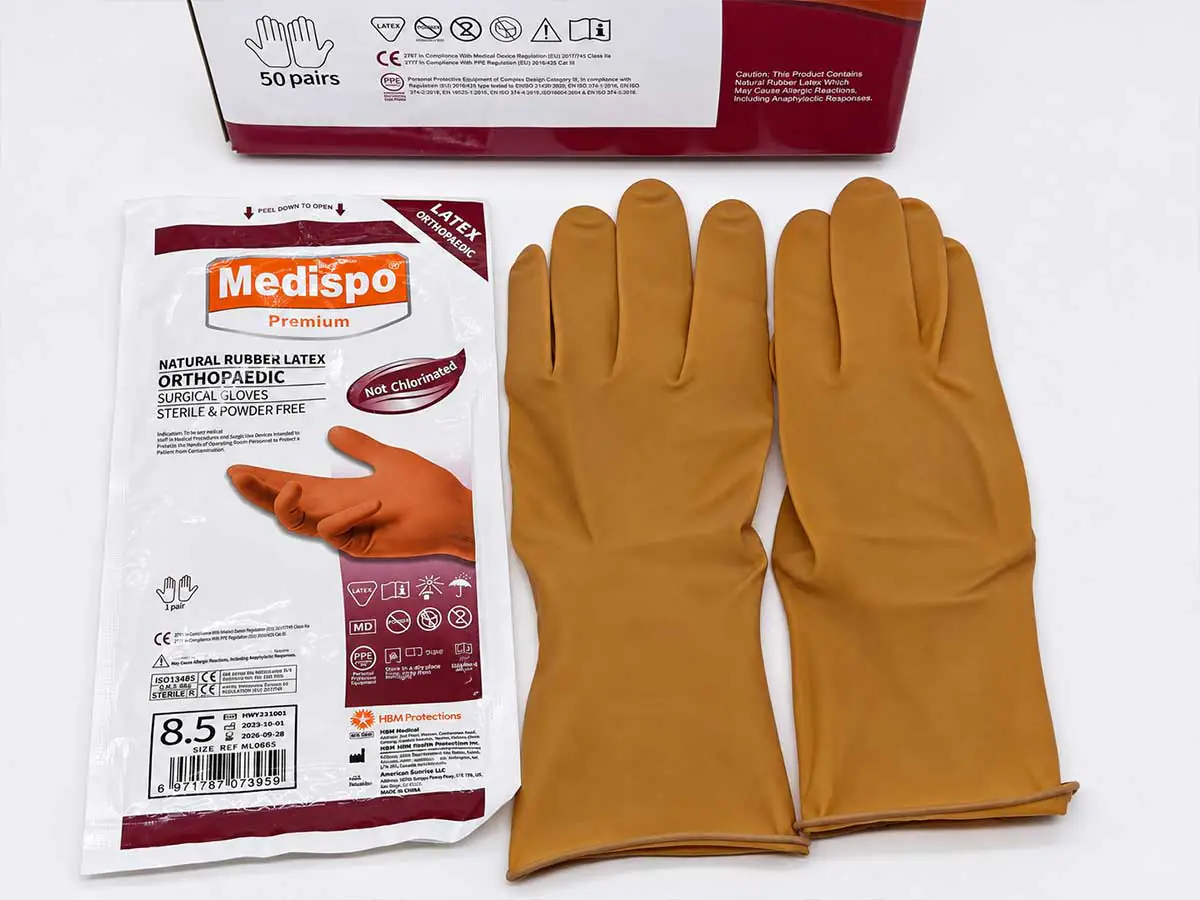
Medispo Latex Orthopaedic Surgical Gloves are made from natural rubber latex and feature a thicker construction within the Medispo latex range.
The nominal fingertip thickness is 0.30 mm, and the nominal palm thickness is 0.27 mm. Buyers whose procurement programs allow natural rubber latex and who want to evaluate a thicker glove can include this model in their sample comparison.
The gloves have a hand-specific design, microtextured surface, and beaded cuff. During evaluation, focus on palm tension when making a fist, instrument grip, and whether fingertip fit supports the intended handling tasks.
Medispo Latex-Free PI Orthopaedic Surgical Gloves
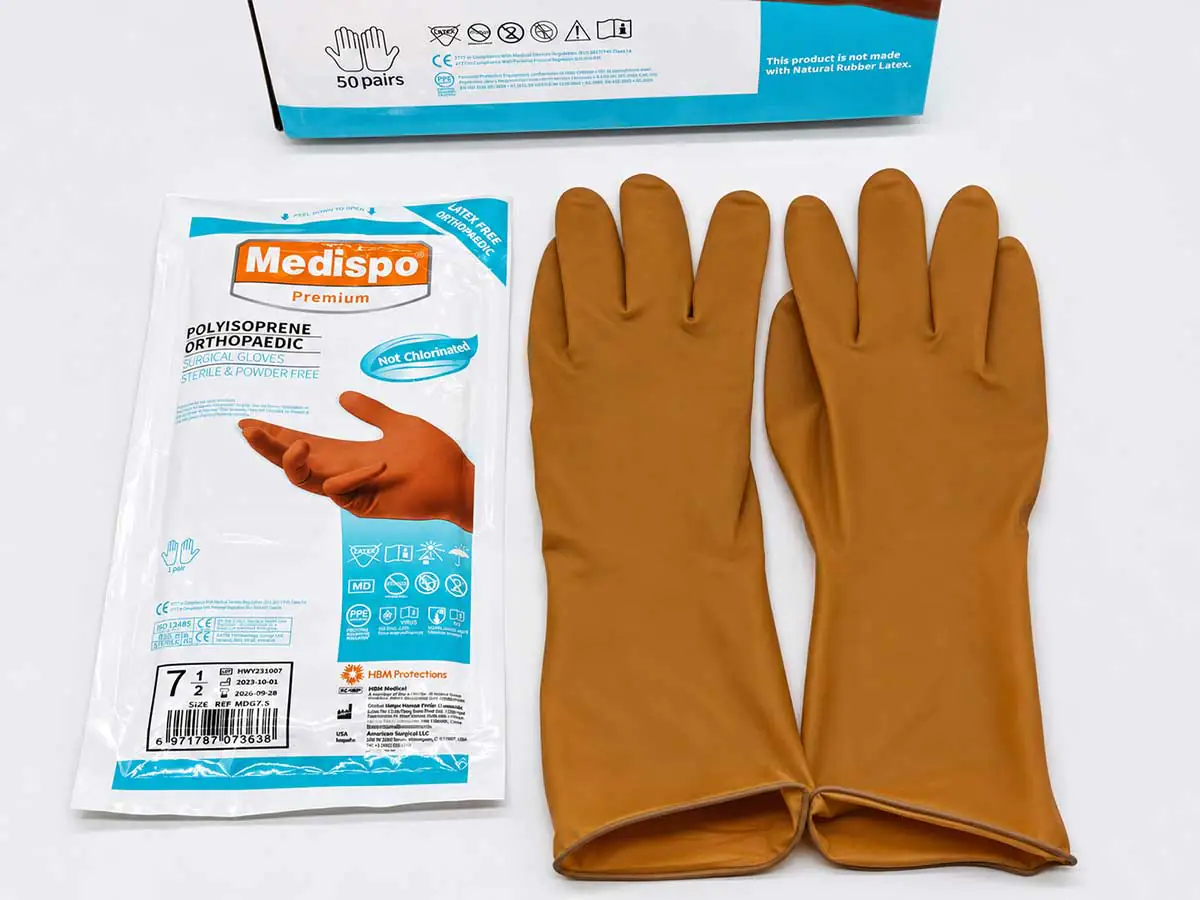
Medispo Polyisoprene Orthopaedic Surgical Gloves are made from synthetic polyisoprene. They provide a thicker option within the Medispo PI range for procurement programs requiring latex-free surgical gloves.
The nominal fingertip thickness is 0.26 mm, and the nominal palm thickness is 0.24 mm. These measurements are lower than those of the latex orthopaedic model. Sample trials allow buyers to assess whether the construction meets their team’s preferences for thickness, fingertip feedback, and finger movement.
The PI model also has a hand-specific design, microtextured surface, and beaded cuff. Hospitals, distributors, and medical suppliers seeking a latex-free orthopaedic glove can include it in their shortlist.
What Do the Two Models Have in Common, and Where Do They Differ?
Material and nominal thickness are the main differences between the two models.
| Specification | Medispo Latex Orthopaedic | Medispo Latex-Free PI Orthopaedic |
|---|---|---|
| Model series | MLOG | MPOG |
| Material | Natural rubber latex | Synthetic polyisoprene, latex-free |
| Nominal fingertip thickness | 0.30 mm | 0.26 mm |
| Nominal palm thickness | 0.27 mm | 0.24 mm |
| Nominal cuff thickness | 0.20 mm | 0.18 mm |
Both models share the following specifications:
| Shared Specification | Both Models |
|---|---|
| Colour | Brown |
| Powder status | Powder-free |
| Surface | Microtextured |
| Cuff | Beaded |
| Design | Hand-specific |
| Sterilization | Electron beam |
| Size range | 5.5–9.0 |
| Shelf life | Three years |
| Thickness tolerance | ±0.03 mm |
The latex model has higher nominal thickness values, while the PI model offers a thinner, latex-free option within the orthopaedic range. Start with your material requirements, then trial the shortlisted models to compare fit, grip, and finger movement.
Specifications are based on the Medispo product catalog. Confirm the latest model-specific documentation and order specifications before purchasing.
How Should Buyers Select Orthopaedic Surgical Gloves?
Start with material requirements, then compare specifications and wearer feedback.
If the procurement program requires latex-free gloves, focus the evaluation on the PI orthopaedic model. If natural rubber latex is permitted, both models can be included in the comparison.
Begin with the same labelled size, then adjust according to actual fit. Check for excess room at the fingertips, tightness around the base of the thumb, and material bunching across the palm.
Use familiar instruments to assess gripping, rotating, releasing, and finger flexion. Record specific observations. Feedback such as “the palm feels tight when making a fist” or “extra fingertip material affects small-instrument handling” is more useful for comparison than a general preference alone.
If double gloving is planned, assess the intended inner and outer combination and calculate the cost of the complete configuration.
Before confirming a model, review packaging, sterilization, shelf life, and the product documents required for the destination market. Where purchasing requirements refer to EN 455, ASTM D3577, or other standards, confirm the relevant model, standard edition, and scope of testing.
What Orthopaedic Glove Supply Support Does HBM Protections Provide?
HBM Protections is a medical protective products manufacturer based in Guilin, China. It manufactures Medispo surgical gloves and provides branded supply and OEM/ODM services. Its orthopaedic glove options include natural rubber latex and latex-free PI models for distributors, medical suppliers, and healthcare brands.
HBM Protections operates 20 surgical glove production lines with annual capacity exceeding 500 million pairs. Each glove is 100% air inflated and undergoes 7-stage quality inspections before delivery.
To compare Medispo orthopaedic surgical gloves, contact HBM Protections with your destination market, material requirements, preferred sizes, single- or double-gloving needs, and estimated quantity. The team can discuss specifications, sample arrangements, quotations, and custom packaging options.