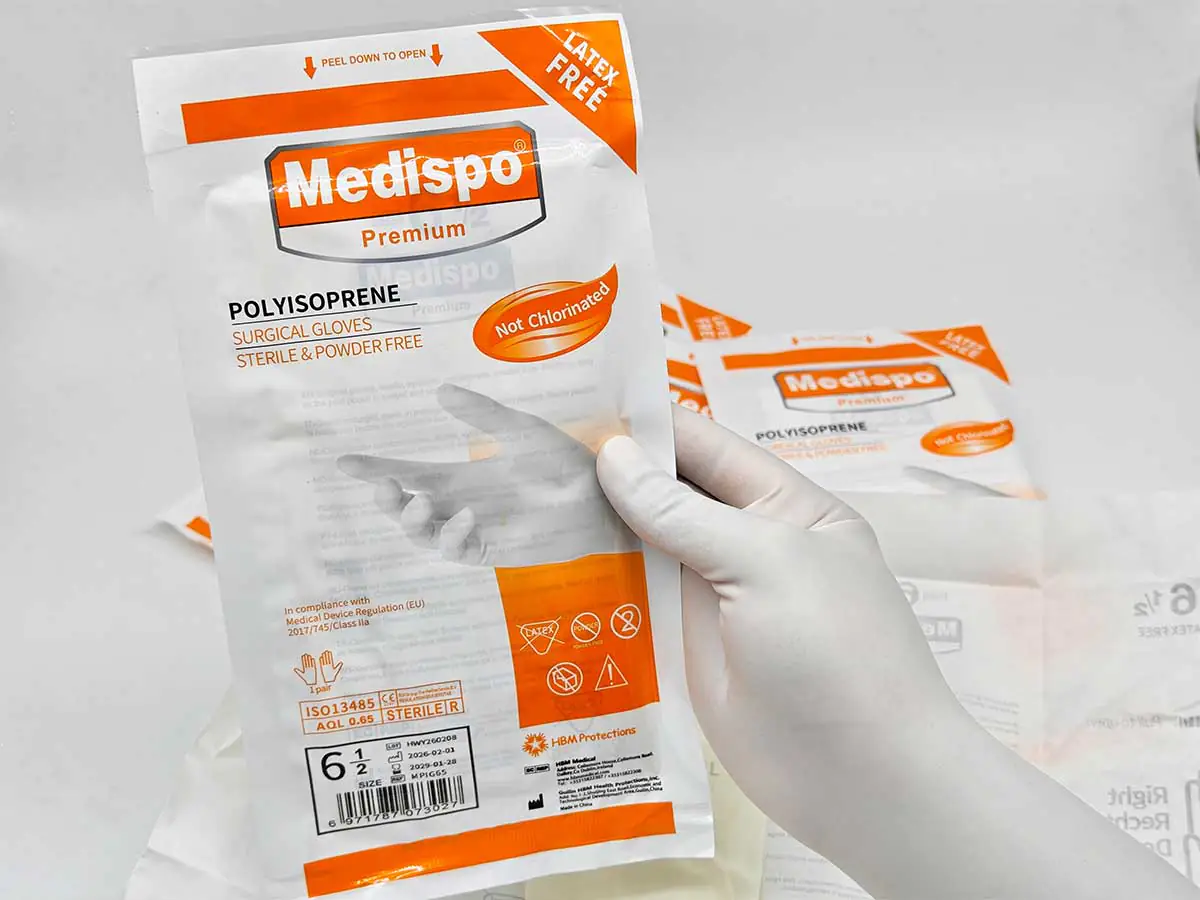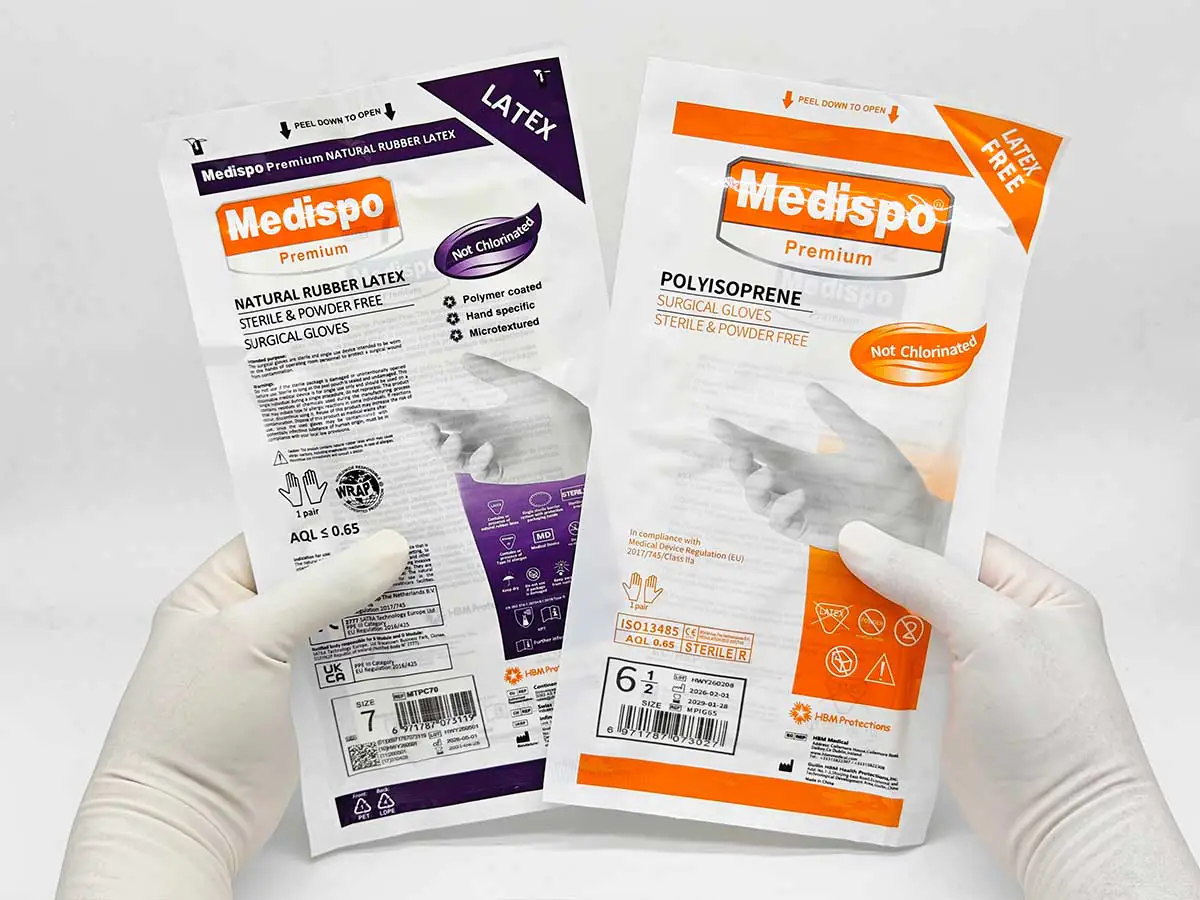
Polyisoprene (PI) is a synthetic rubber used to make surgical gloves without natural rubber latex. It offers a feel and stretch similar to natural latex, which makes PI worth sampling when a team wants to avoid natural rubber latex while keeping a familiar glove feel.
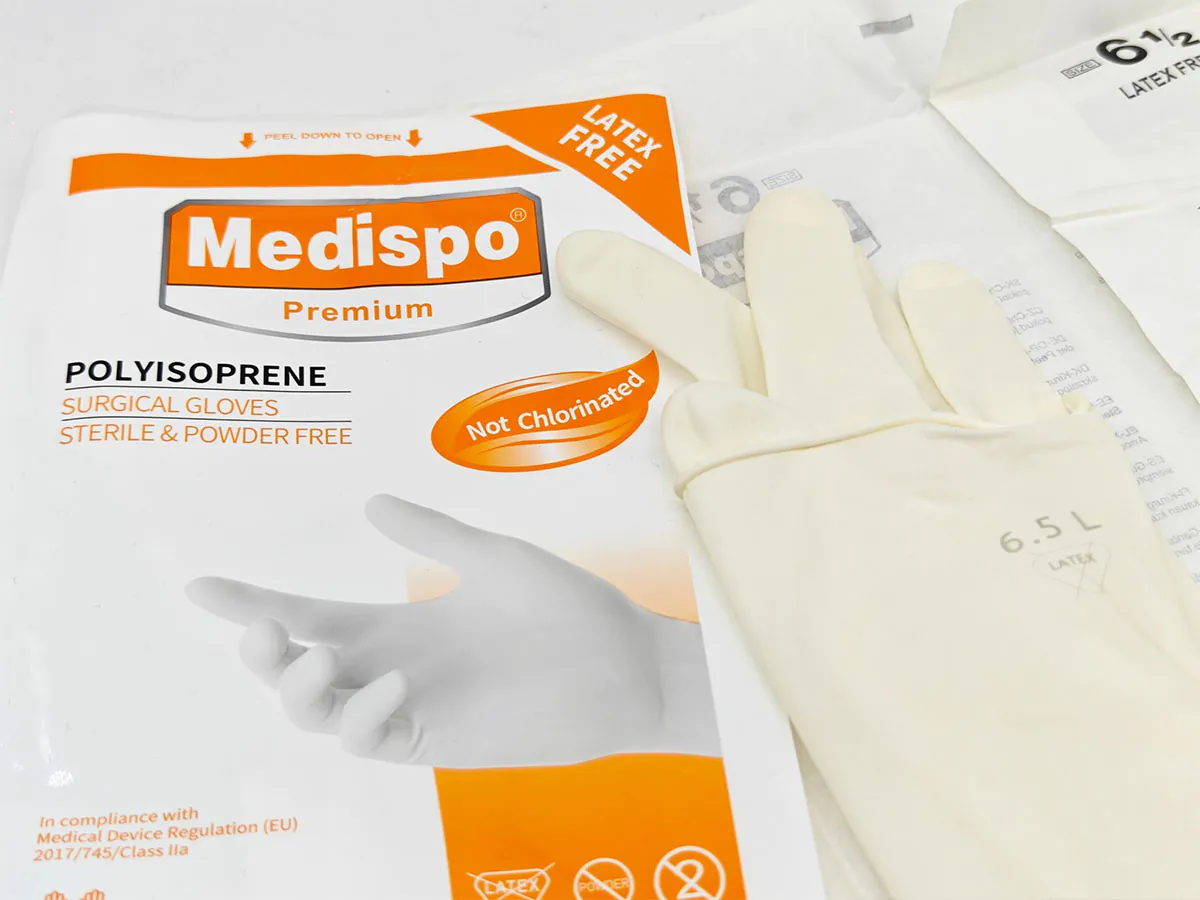
HBM Protections manufactures the Medispo® polyisoprene surgical glove range in Guilin, China. The range includes a standard glove for routine use, a Sensitive model for teams that prioritise fingertip feel, and a thicker Orthopaedic model. For double gloving, there is a separately supplied blue underglove and a set with the inner and outer gloves supplied together.
How Do the Five Medispo® PI Options Compare?
| Model | Fingertip / palm / cuff thickness | Colour and configuration | When to consider it |
|---|---|---|---|
| PI Standard (MPIG) | 0.23 / 0.21 / 0.16 mm | Cream white | A starting point for routine use and a baseline for comparing fit and feel |
| PI Sensitive (MPSE) | 0.21 / 0.19 / 0.15 mm | Cream white | Fine instrument handling where fingertip feel is a priority |
| PI Orthopaedic (MPOG) | 0.26 / 0.24 / 0.18 mm | Brown | Orthopaedic procedures involving frequent instrument handling, sharp bone edges or bone fragments |
| PI Blue Underglove (MPUG) | 0.21 / 0.20 / 0.15 mm | Blue inner glove, supplied separately | Evaluating a contrasting inner glove with a proposed outer glove |
| PI Double-Gloving Set (MPSD) | — | White PI Sensitive outer glove and blue PI inner glove | Trialling the two Medispo gloves together as a set |
Thicknesses shown are nominal values with a tolerance of ±0.03 mm.
Standard, Sensitive or Orthopaedic: Which Should You Sample First?
Start with Standard for routine use. Try the labelled size each wearer normally uses. Check for extra material at the fingertips, tightness across the palm when making a fist, and movement at the cuff. If the team is replacing an existing glove, include that model in the same trial so wearers can compare the fit directly.
Add Sensitive if fingertip feel matters most. Its nominal fingertip and palm thicknesses are each 0.02 mm lower than those of the Standard model. Have the same wearer try both gloves in the same labelled size and repeat a simple task, such as picking up and repositioning a small instrument. Ask whether the instrument’s edges are easy to feel and whether the grip feels steady.
Consider Orthopaedic for procedures involving sharp bone edges, bone fragments or frequent instrument handling. It is also worth trialling for longer orthopaedic procedures with substantial instrument handling. It has the highest nominal thickness of the Medispo PI models sold as individual pairs, measuring 0.26 mm at the fingertip and 0.24 mm at the palm. A same-size trial alongside Standard can help the team judge fit and finger movement while gripping instruments.
Why Choose Double Gloving With Contrasting Colours?
A second glove adds a barrier between the outer glove and the skin. In orthopaedic and trauma procedures, sharp bone edges, fragments and instruments can damage a glove. If the outer glove is breached, an intact inner glove still provides a barrier. A systematic review of double gloving found fewer perforations in the glove closest to the skin with double gloving than with single gloving.
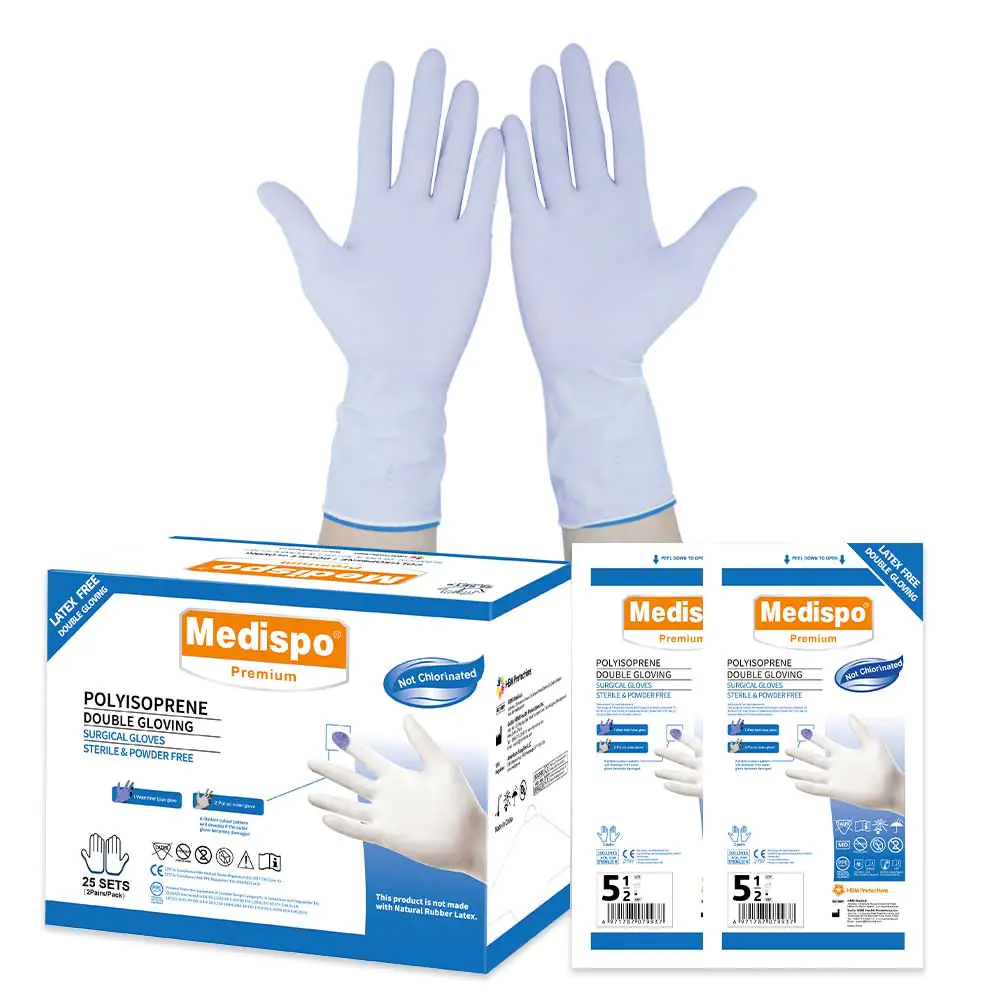
Contrasting colours help the wearer spot an outer-glove breach. The Medispo set pairs a white outer glove with a blue inner glove. If fluid passes through a breach in the outer glove, a more visible blue spot may appear around the affected area, helping the wearer identify the breach and change the glove promptly.
If the team already has an outer glove in mind, the Medispo PI Blue Underglove can be trialled with that model to assess how the layers feel together. The Medispo PI Double-Gloving Set gives the team a ready-made pairing to evaluate, with one pair of white PI Sensitive outer gloves and one pair of blue PI inner gloves.
How to Compare Samples Side by Side
Have the same wearer perform the same instrument-handling task with each sample. Note fingertip fit, freedom of movement and grip. For double gloving, trial the intended inner and outer gloves together. Pay particular attention to extra material at the fingertips, tightness across the palm and how the cuffs sit when the wrist moves.
If you would like to compare Standard, Sensitive, Orthopaedic or a double-gloving option, share your preferred models and usual glove sizes with HBM Protections so the team can help arrange samples for a side-by-side trial.