
When sourcing surgical gloves, buyers often encounter ASTM D3577 in product specifications, tender documents and supplier communications. Understanding what the standard covers—and how supporting documentation relates to a particular product—helps make supplier comparisons more useful.
For distributors, importers and private-label brands, the practical question is more specific than whether a supplier mentions ASTM. Buyers need to know which standard edition applies, which product was evaluated and what the available evidence actually supports.
What Is ASTM D3577?
ASTM D3577 is a specification for rubber surgical gloves. Its scope addresses packaged sterile gloves used in surgical procedures, including natural rubber latex and synthetic rubber latex types.
It provides a reference for evaluating defined product requirements. Buyers should distinguish it from standards intended for examination gloves or testing directed at a particular chemical or biological hazard.
A useful starting point is to identify the product category, material and intended use before deciding which standards and documents are relevant.
What Does ASTM D3577 Evaluate?
The specification addresses several aspects of surgical glove performance. The following overview explains the main areas buyers may encounter; it does not replace the applicable standard or its detailed requirements.
| Evaluation Area | What It Addresses |
|---|---|
| Freedom from holes | Assessment of leakage associated with holes in the glove |
| Physical dimensions | Measurements such as width, length and thickness |
| Mechanical properties | Characteristics such as tensile strength and elongation |
| Performance after accelerated aging | Mechanical performance following specified aging conditions |
| Powder-related requirements | Powder or residual powder, according to the product type |
| Protein-related requirements | Relevant protein measurements, where applicable |
| Sterility | Requirements associated with the sterile product |
These areas answer different questions. A dimensional result does not establish barrier performance, and a mechanical test does not independently establish sterility.
When reviewing evidence, buyers should identify which requirements were evaluated and what additional documentation supports the finished product.
Does ASTM D3577 Apply to Latex-Free Surgical Gloves?
ASTM D3577 includes synthetic rubber latex types as well as natural rubber latex types. It is therefore relevant when evaluating suitable synthetic rubber surgical gloves, including polyisoprene products.
However, the material name alone does not establish conformity. Buyers should confirm the selected product’s classification, specifications and applicable requirements.
For a latex-free range, review the documentation for the proposed polyisoprene surgical gloves. For natural rubber latex products, assess the corresponding latex surgical glove range separately.
A report for one material or model should not automatically be treated as evidence for another.
How Should Buyers Read an ASTM Test Report?
Start with the sample description and conclusion rather than looking only for the word “Pass.”
The sample information connects the evidence to the product. The conclusion establishes the scope of the findings.
| Check | Questions to Ask |
|---|---|
| Product identity | Does the description match the material, model and product being purchased? |
| Manufacturer | Is the manufacturer identified, and is its relationship to the supplier clear? |
| Sample details | Which sizes, batches or reference numbers were tested? |
| Standard edition | Which edition and test methods are listed? |
| Testing scope | Were all relevant requirements assessed, or only selected tests? |
| Results | What measurements, acceptance criteria and conclusions are reported? |
| Dates and changes | Does the evidence remain relevant to the current product configuration? |
For example, a conclusion stating that submitted samples met selected test requirements has a narrower meaning than a statement addressing all applicable requirements of a specification.
The report date also needs context. An older report is not automatically irrelevant, but buyers should ask whether the materials, manufacturing process or product specifications have changed since testing.

Common Misunderstandings About ASTM Claims
A Test Report Is Not Automatically a Product Certification
“Tested to ASTM D3577” should be read alongside the report’s actual scope. A laboratory report should not automatically be described as an “ASTM certification certificate.”
Likewise, an overall conformity statement requires supporting evidence for the applicable requirements. One successful test does not establish every aspect of product conformity.
Powder-Free Does Not Mean Absolutely No Residue
Powder-free is a product designation that should be supported by the applicable residual-powder requirements and testing.
Buyers should check the method, units, result and acceptance criterion rather than interpreting the label as a claim of absolute zero residue. Powder-free also does not mean latex-free or guarantee that a product cannot cause an allergic reaction.
ASTM Testing Does Not Replace Regulatory Requirements
A testing standard and market authorization serve different purposes.
For the United States, the FDA’s medical glove information describes medical glove regulation and the 510(k) premarket notification requirement. An ASTM test report is not a substitute for the applicable regulatory documentation.
Buyers should separately confirm the product’s regulatory status for the intended destination.
What Additional Testing May Be Needed?
The intended use determines whether further evidence is needed.
For example, ASTM D6978 addresses the assessment of medical glove material resistance to permeation by chemotherapy drugs. This is a different evaluation from the surgical glove specification.
Buyers considering chemotherapy-related use should review the specific drugs, test conditions, results and applicable labeling. A D3577 reference alone does not establish suitability for handling chemotherapy drugs.
Similarly, claims about biological barriers, chemical resistance or other specialized protection should be supported by evidence appropriate to the claim and selected product.
Selecting Surgical Gloves from HBM Protections
HBM Protections manufactures Medispo latex and polyisoprene surgical gloves for branded supply and OEM/private-label projects.
Our surgical glove testing documentation covers selected evaluations under ASTM D3577, D5151, D6124, D6499, D5712 and D6978, addressing surgical glove requirements, freedom from holes, residual powder, antigenic latex protein, aqueous extractable protein and chemotherapy drug permeation, respectively.
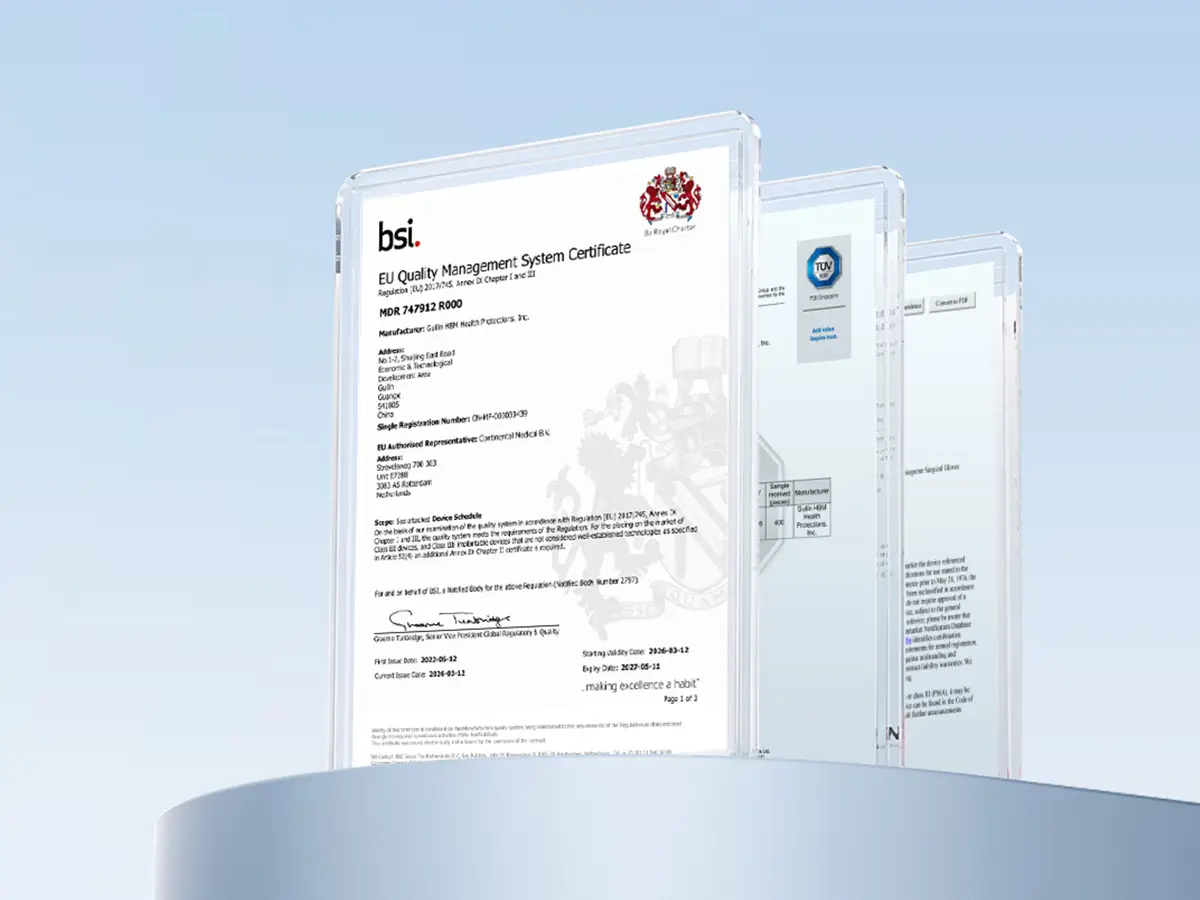
The applicable testing scope varies by material, model and test item; these evaluations do not apply uniformly to every Medispo glove. Visit our quality certifications page for an overview of company and product-related credentials.
To explore Medispo surgical gloves or discuss the specifications and supporting documentation relevant to your project, contact HBM Protections with your target market, preferred material and procurement requirements.